Category: Info

August 2026 Visa Bulletin

The U.S. Department of State’s August 2026 Visa Bulletin shows movement from the July 2026 Visa Bulletin in most categories under the Final Action Dates chart. U.S. Citizenship and Immigration Services (USCIS) recently announced that it would continue to accept employment-based adjustment of status filings based on the Final Action Dates chart in August 2026.

Quick Hits

  • USCIS will continue to accept adjustment of status filings based on the Final Action Dates chart in August 2026 and will not use the Dates for Filing chart.
  • Many categories under the Final Action Dates chart have moved forward one month.
  • Visas are unavailable for the remainder of the fiscal year for EB-2 applicants from India.

Final Action Dates

The final action dates across many categories have advanced slightly.

  • EB-1: The final action dates for China-mainland advance by one month while the dates for India remain the same. All other countries continue to be current.
  • EB-2: The final action dates for India EB-2 are unavailable for the fiscal year. All other countries remain the same.
  • EB-3: All countries advance except for India and Philippines.
  • EB-4: All countries have advanced from September 15, 2022, to October 15, 2022.
  • EB‑4 Certain Religious Workers: This category has advanced from September 15, 2022, to October 15, 2022.
  • EB-5: No movement is shown.
Employment-
based
All Chargeability
Areas Except
Those Listed
CHINA-
mainland
born
INDIAMEXICOPHILIPPINES
1stC01JUL2315OCT22CC
2ndC01SEP21UCC
3rd01SEP2401JAN2201JAN1401SEP2401AUG23
Other Workers01APR2201MAY1901JAN1401APR2201DEC21
4th15OCT2215OCT2215OCT2215OCT2215OCT22
Certain Religious Workers15OCT2215OCT2215OCT2215OCT2215OCT22
5th Unreserved
(including C5, T5, I5, R5, NU, RU)
C01DEC16UCC
5th Set Aside:
Rural (20%, including NR, RR)
CCCCC
5th Set Aside:
High Unemployment (10%, including NH, RH)
CCCCC
5th Set Aside:
Infrastructure (2%, including RI)
CCCCC

Source: U.S. Department of State, August 2026 Visa BulletinFinal Action Dates Chart

Key Takeaways

With some advancement in final action dates, more applicants will become eligible to complete the final step of the permanent residency process. As visas became unavailable in July, applications in the India EB-2 category will not be processed by USCIS until the new fiscal year in October 2026.
Current Immigration Status

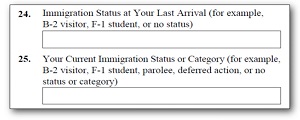
Is my “Current Immigration Status” different than my “Status at Last Entry?”

Part 2, Item 25 on Form I-765, Application for Employment Authorization, asks for “Your Current Immigration Status or Category.” You may or may not have the same immigration status as when you initially entered the United States. Your current immigration status, which is generally identified by a visa category, describes the basis of your lawful immigration status in the United States.

Screen shot of current immigration status on Form I-765

When you most recently entered the United States, immigration officials likely assigned you an immigration status. This was your status at last entry. Typically, you can find your status at last entry on your nonimmigrant visa or Form I-94. However, if you changed your status since arriving, your visa category may be different. In this case you can likely find your current immigration status on a Form I-797A, Notice of Action.

Did you know minor mistakes on your Form I-765 application can cause costly delays and rejections? Prepare your I-765 quickly and correctly with CitizenPath. The attorney-reviewed software guides you through the application and provides help to answer questions like this one. And personalized filing instructions help you to file your application today knowing that you did everything right! No credit card or signup required to try it.

Change of Status Example

Change of status is not common. The most common requests are to change to a nonimmigrant student or to a nonimmigrant worker. For example, an individual might enter on an F-1 student visa. Near graduation, the student is offered employment with a company that is willing to sponsor. In this example, the foreign national entered on an F-1 visa but is currently in the United States on an H-1B.

No Status Example

In a similar way, it’s possible that a nonimmigrant doesn’t have any current immigration status. In this case, he or she would have no lawful status in the United States. For example, a person that enters the United States on a B-2 visitor visa and fails to leave before the expiration date on Form I-94 does not have a valid immigration status. (Note: The duration of stay is dictated by the I-94, not the visa.) The person’s current immigration status in this case is “No Status.”

Rescheduling a Naturalization (Citizenship) Interview

Rescheduling a Naturalization (Citizenship) Interview

If you’ve submitted USCIS Form N-400 for naturalized citizenship, and cannot attend the scheduled interview, then you will need to send a letter to USCIS before the date the interview was scheduled. Use the address of the USCIS office on the bottom of the interview notice (Form I-797C).

Briefly explain in the letter why you cannot attend, and request an interview date at a later time. (Also mention your first possible availability, for example if you will be hospitalized for the next five weeks.) Enclose the interview notice that USCIS sent you, after making a copy for yourself.

If you can’t send the notice before the interview, you can still file a motion to reopen under 8 C.F.R. 103.5, but would be wise to get an attorney’s help.

For all other types of reschedule requests, read your notice from USCIS or consult an attorney.

What do I need to start working in the US?

US visas overview

Many types of work visas allow non-citizens to work in the United States. Some allow you to work for a temporary period of time, and others provide a path to permanent residence. Find out if you are eligible for a temporary or permanent work visa.

What do I need to start working in the US?

As a noncitizen, you may work in the US if you have either a temporary work visa or a permanent work visa. You may also work in the US if you are a foreign student, a refugee who has been granted asylum, or a lawful permanent resident.

What are temporary work visas?

Temporary work visas, also called non-immigrant work visas, allow you to work in the United States for a specified period of time. The Immigration and Nationality Act (INA) provides numerous types of temporary visas, including visas for:

  • Employees whose employer wishes to transfer them to work in the US
  • People from specified countries who wish to engage in international trade
  • Individuals with specialized skills, occupations, or extraordinary abilities
  • Trainees in special educational programs
  • Special religious workers

Common types of temporary work visas include H1-B visas, L-1A visas, L-1B visas, and J-1 visas.

H1-B specialty occupation visas

Though there are three types of H1-B visas, the H1-B1 visa is the most common. It allows non-citizens with bachelor’s degrees or higher to accept job offers in the United States. If you hold a foreign degree, it must be the equivalent to a US bachelor’s degree or higher. For this type of visa, the job that you wish to pursue must relate to the degree that you have. Your employer must petition for you by filing forms ETA-9035 and I-129.

L-1A and L1-B intracompany transferee visas

L-1A non-immigrant visas allow US employers to transfer executives or managers from a foreign office to an employer’s US office. It also allows a foreign company that does not yet have a US office to send an executive or a manager to the United States in order to establish one. L1-B visas enable US employers to transfer employees with specialized skills in a similar manner as L1-A visas. For either visa, the employer must file form I-129 on behalf of the employee.

J-1 exchange visitors visa

J-1 visas allow non-citizens to attend approved exchange programs to study education, arts, and science. Exchange visitors may include professors, scholars, research assistants, students, trainees, teachers, specialists, nannies, and camp counselors.

If you would like to work based on a J-1 visa, you must submit form DS-2019 with the Department of State, and your employer or school must sponsor you. If you are granted a J-1 visa, your spouse and children are also allowed to work in the US.

What are permanent work visas?

If you wish to immigrate to the US rather than work temporarily, consider applying for a permanent work visa, also called an immigrant work visa. Because the US only approves 140,000 immigrant work visas per year, the 5 types of permanent visas are organized into 5 preference categories.

  • EB-1 visas allow highly trained people of “extraordinary ability” in the sciences, arts, education, business, or athletics to immigrate based on their professional success.
  • EB-2 visas provide work visas for those who hold advanced degrees or have exceptional abilities in the arts, sciences, or business.
  • EB-3 visas are for professionals, skilled workers, and other workers.
  • EB-4 visas are reserved for “special immigrants,” including some religious workers, retired employees of international organizations, and minors who are wards of courts.
  • EB-5 visas allow business investors to invest $1 million in a new commercial enterprise that employs at least 10 full-time employees.

How do I know if I am eligible to work in the United States?

Eligibility is determined by your education, skills, and goals. An immigration attorney who specializes in employment issues will help you choose which visa to apply for, and can even help you complete and file your application.

The United States has several dozen different types of visas, and processes millions of applications annually. However, most people enter on a small handful of the overall available visa types. Some of the most common include the B1 business visa and the B2 tourist visa (often issued together as a B1/B2), the F-1 student visa, the H-1B specialty occupation visa, the H-4 dependent visa, the J-1 exchange visa, and the K-1 fiancee visa.

Each of these visa types has their own requirements. You can learn more about them in the table below. However, because immigration law is constantly changing, it’s always a good idea to consult an immigration lawyer before filing an application.

What is the differences between local police and federal immigration officers?

What is the differences between local police and federal immigration officers?

If you are stopped by authorities, it could be:

  • State Highway Patrol
  • Local city police or Sheriffs
  • Immigration and Customs Enforcement (“ICE”)
  • U.S. Customs and Border Protection (“CBP”) within 100 miles of border.

If you can’t tell what they are, you can ask!

What are my rights if I am stopped by local police?

The police officer should quickly tell you why you are being stopped. If they don’t tell you, you should ask.If they think you may have committed a crime, they can ask for your name and address. You have to tell them.They cannot ask for ID unless you are driving. Therefore, if you are not driving, you should tell them your name and address. But before you provide an ID, you should ask if you are under arrest! If not, tell them that you don’t need to show them an ID.They cannot search you unless they have some good reason to think you have a weapon. You should say: “I do not consent to a search.”If you are driving, you have to show them your driver’s license, vehicle registration, and proof of insurance.You should not answer questions that you are not comfortable answering, like questions about your immigration status.

What if I only have a Mexican driver’s license?

You can drive with a Mexican license, but only if you are a visitor. If you live in a state for several months, you are likely a resident, and you cannot use your Mexican ID. If you show a Mexican ID, you may only be highlighting your Mexican nationality.If you don’t have a driver’s license, then tell them you don’t have it. They will ticket you for this, but they shouldn’t contact immigration.If they are calling ICE, but they are not giving you a ticket for anything else: Ask, “Am I under arrest?” If not, they can’t hold you while they wait for ICE to arrive! Ask them if you are free to go.

What should I do if I am stopped by immigration authorities?

Immigration authorities are different from local police. Local police cannot ask about immigration, but federal authorities can.What can ICE demand from you? They can demand you show them “alien registration” documents. Examples include a permanent resident card (“green card”), an I-94 admission document (the white document that you may have gotten when entering the country), Employment Authorization Document, or a border crossing card. If you don’t have these, it can be a minor crime they can arrest you for. However, it is very rare to be arrested for not having these documents with you.Do not show fake IDs! If you either don’t have documents or yours are expired, you can calmly state that you do not want to answer any questions until you get an attorney. This is your right.

Do you have to let immigration officers in your house?

No, not without a warrant. If they say they have one, ask to see it. Do not step outside. The warrant must specifically say they can enter your house. If not, then they cannot enter your home without your agreement.You may choose to share some basic information with the officers, but you should never make a sworn statement. Sometimes they want to interview you and record it. It is typically not in your best interest to agree to this. You can say you are not talking without your attorney. You have a right to an attorney before talking.Any information you provide will only be used against you. It is not rude to refuse to talk. It is your right.

What happens if I am arrested by immigration authorities and placed into proceedings?

You will almost always get a chance to see an Immigration Judge if you request it. However, if you have a final order of deportation against you, or you were previously deported, then you may not have a right to see an Immigration Judge.You should never agree to voluntary departure unless you are absolutely sure that you want to go back to your home country.Don’t sign anything unless you understand what it says!You should usually try to talk to an immigration attorney, because you may have some defense available to you that you don’t know about, so you can stop the deportation!The immigration officers who arrested you have the right to release you from detention while you wait for your hearing in Immigration Court. You might be released on your own, or you might have to pay a “bond” to be released from detention. A bond is a cash payment that they take from you, and you get the money back after the proceedings are over. They do this to make sure that you attend the hearing they schedule for you.You could be moved out of state while you wait to pay bond. You should try to set aside some money so that in case you ever need to post a bond you can afford to pay for it and get released from detention.You will be given the chance to make a phone call. Keep an attorney’s number with you in case you need to call from a detention facility.

Know Your Rights When Dealing with Law Enforcement

Know Your Rights When Dealing with Law Enforcement

It is important for all of us, regardless of immigration status, to know how to exercise our rights if we are stopped by local police or immigration authorities. We all know that in many parts of our country, there is not a lot of racial or ethnic diversity. Sometimes, that means that law enforcement officers single out people of color, or people who look or sound different than the “average” person. This is called racial profiling, and it is against the law.We all have an obligation to stand up against racial profiling, because that is the only way to prevent it from happening. Racial profiling has a serious impact on immigrants living here with or without legal status. Many lawfully residing immigrants experience added hassles and burdens when going about their lives simply because they look or sound different. In addition, most of the time when immigrants who do not have legal status are discovered and put into deportation proceedings, it is because they were pulled over by local police for violations like speeding, having a broken tail-light, or suspicion of driving under the influence of alcohol. Some of these stops were based on racial profiling.

Do I have to answer questions about my immigration status if a local police officer asks?

Local police or the Highway Patrol are not immigration officers. They are not authorized by law to investigate or arrest people for their immigration status, and have no right to ask questions about your immigration status. You do not have to answer these questions, and we suggest that you do not.In some states like Arizona, Alabama, and Georgia, they recently passed laws allowing police to ask these questions. However, most states do not have these laws. If you are stopped by police, you have the right to remain silent and politely decline to answer questions about your immigration status, and you should exercise that right! To protect all of us, you should not answer questions about your immigration status even if you are a citizen or legal resident, because these questions are not appropriate.There are only a few things you actually have to tell the police. You must tell them your name and address. If you are driving, you have to show a driver’s license, vehicle registration, and proof of insurance. If you don’t have any of these documents, you may get a ticket and have to go to court.

Naturalization Through Military Service

If you are serving or have served in the U.S. armed forces and are interested in becoming a U.S. citizen, you may be eligible to apply for naturalization under special provisions of the Immigration and Nationality Act (INA).

Eligibility

If you meet all of the requirements of either section 328 or 329 of the INA, you may apply for naturalization by filing Form N-400 under the section that applies to you. You will not have to pay any fees for applying for naturalization under INA 328 or 329. As a member or veteran of the U.S. military, certain other naturalization requirements may not apply to you; for example, if you are currently active duty, you may not have to reside in or be physically present in the U.S. for any length of time before you apply for naturalization. The requirements for naturalization are explained in greater detail below.


If you served honorably in the U.S. armed forces for at least one year during a period of peacetime, you may be eligible to apply for naturalization. While some general naturalization requirements apply under INA 328, other requirements may not apply or are reduced. To establish eligibility under INA 328, you must:

  • Have served honorably, during a period of peacetime, in the U.S. armed forces for a period or periods totaling one year;
  • Have submitted a completed Form N-426, Request for Certification of Military or Naval Service (PDF, 418.02 KB), at the time of filing the N-400 to demonstrate honorable service;
  • Be a lawful permanent resident at the time of your naturalization interview;
  • Meet certain residence and physical presence requirements;
  • Demonstrate the ability to read, write and speak English;
  • Demonstrate knowledge of U.S. history and government;
  • Demonstrate good moral character for at least five years before filing your N-400 through the day you naturalize; and
  • Demonstrate an attachment to the principles of the U.S. Constitution.

For additional information on eligibility USCIS Policy Manual Volume 12, Part I – Military Members and Their Families.


INA 329 applies to all current military service members or veterans who served honorably in an active-duty status or in the Selected Reserve of the Ready Reserve during any of the designated periods of armed conflict listed below:

  • Sept. 1, 1939 – Dec. 31, 1946
  • June 25, 1950 – July 1, 1955
  • Feb. 28, 1961 – Oct. 15, 1978
  • Aug. 2, 1990 – April 11, 1991
  • Sept. 11, 2001 – present


Many military installations have a designated USCIS liaison to help you with the naturalization application process. These liaisons are typically assigned to a specific office (for example, your installation’s community service center, DOS family liaison office or Judge Advocate General). Ask your chain of command to certify your honorable military service on Form N-426, Request for Certification of Military or Naval Service. If you have already separated from the U.S. armed forces, you may submit an uncertified Form N-426 with a photocopy of your DD Form 214, Certificate of Release or Discharge from Active Duty, or NGB Form 22, National Guard Report of Separation and Record of Service, for the applicable periods of service listed in Form N-426. Mail your completed application and all required materials to:

USCIS
P.O. Box 4446
Chicago, IL 60680-4446

You may also complete your application by creating an online account and filing your Form N-400 online. For more information about filing your application online, visit our Form N-400 webpage.

We will review your application and conduct required security checks, which include obtaining your fingerprints. This can be done in one of the following ways: 

  • If you were fingerprinted for a previous immigration application, we will use these fingerprints, if available.
  • If stationed abroad, you may submit two properly completed FD-258 fingerprint cards and two passport-style photos taken by the military police or officials with the Department of Homeland Security, U.S. embassy, or U.S. consulate.
  • If you have questions regarding your biometrics, you can contact the Military Help Line at 877-CIS-4MIL (877-247-4645, TTY: 800-877-8339) or militaryinfo@uscis.dhs.gov.

We allow you to submit your fingerprints at an application support center before you file your Form N-400. Be sure to include your A-Number and show your unexpired military ID card or Delayed Entry Program ID card.

We will review your application and send it to a USCIS field office to schedule you for an interview. You can request an interview at a specific office in a cover letter attached to your application or leave the choice of location to us.

The field office will schedule your interview to review your eligibility for naturalization and test your knowledge of English and civics. If we find that you are eligible for naturalization, we will inform you of the date you can take the Oath of Allegiance and become a U.S. citizen.

Forms

You must complete and submit:

Posthumous Citizenship for Military Members

Generally, individuals who served honorably in the U.S. armed forces and died as a result of injury or disease incurred while serving in an active-duty status during specified periods of military hostilities may be eligible for posthumous citizenship under section 329A of the INA.

You must file Form N-644, Application for Posthumous Citizenship, on behalf of the deceased service member within two years of their death. Upon approving the application, we will issue a Certificate of Citizenship in the name of the deceased veteran establishing posthumously that they were a U.S. citizen on the date they died.

Other provisions of the law extend immigration benefits to the service member’s surviving spouse, children, and parents. For information, see the Family Based Survivor Benefits page.

Find Study Materials for the Naturalization Interview and Test

Before your naturalization interview, be sure to study for the English and civics test by using our free resources to help you prepare. 

The English language test has not changed. Continue to find study materials for the English test on the Study for the Test page.

K1 visa document file

Apply for the K1 visa

You can start your K1 visa application after the approval of Form I-129F. This must be completed by the foreign citizen in a US Embassy or Consulate in their country of residence.

Complete Form DS-160

Form DS-160, Online Nonimmigrant Visa Application is used for US nonimmigrant visas and in this case for the K1 visa too. The form will inquire on your personal information as well as reasons why you are planning to go to the US. When you submit it, you will get a confirmation page and code.

Schedule the US Fiance visa interview

Your visa interview will be conducted if you are between 14 and 79 years old. To complete the interview, you must first schedule it. You must schedule it as soon as possible due to the fact that you might have to wait too long if the Embassy or Consulate you are applying from has a high workload. When you schedule the interview, you will get an interview schedule letter.

Complete medical examinations

No matter your age, if you are traveling to the US and especially planning to apply for a US immigrant visa in the future, you must have a licensed physician conduct the necessary medical examination. The doctor must write the report stating any health issues. Since the fiancé will get married soon and apply for permanent residence, it is also advisable to get the necessary US required vaccination so as to complete that requirement.

Compile your K1 visa document file

When you go in for your interview at the US Embassy, you must present the K1 visa required documents.

Here are the documents that you should submit for a K1 visa:

  • Valid passport for more than 6 months after your intended stay in the US.
  • Two recent US visa photographs according to the Photo Requirements.
  • Form DS-160 confirmation page and code.
  • Interview schedule letter.
  • Approved Form I-129F.
  • Criminal background documents.
  • Divorce or death certificates in case of a previous marriage.
  • Evidence of the relationship with the US citizen.
  • Medical examination documents (and optional for vaccination documents).
  • Proof of payments of fees.

Attend visa interview

During the interview, you will have to show your documents as well as answer any questions that the interview officials will have. The interviewer will also ask questions about your relationship with the US citizen as well as other details about your background.

Can I Apply for a K1 Visa

What is a K1 visa?

A K1 visa is a US immigrant visa issued to the fiancé or fiancée of a US citizen to enter the United States.

The K1 visa holder will get this visa so that they can marry the US citizen within 90 days of arriving in the US. This K1 fiance visa is the first visa that a foreign citizen marrying a US citizen must have. Without having had the K1 visa, the fiancé of the US will then have difficulty adjusting the status to become a Legal Permanent Resident (LPR) of the US.

The ceremony and the legal marriage certificate must be performed and submitted as proof to the Department of Homeland Security in order to initiate the permanent move of the foreign citizen in the US to join their spouse.

Can I Apply for a K1 Visa?

To be able to get the K1 visa and travel to the US to marry the US citizen, there are first a few fiancé visa criteria that you must fulfill. These requirements are in place to prevent unofficial relationships and marriages to only obtain Green Cards.

So if you want to marry your fiancé in the US, you must fulfill these eligibility criteria:

  • You must have proof of your relationship before the engagement.
  • You plan on getting married while you are in the US on a K1 visa.
  • The marriage will be performed according to the US laws where the marriage will be done.
  • You and the US citizen must have met in person at least once in the past two years (Exceptions to this requirement will be granted if you can prove that the US citizen faced extreme hardship to come and visit the foreign citizen fiancé. Extreme hardship can be proved on conditions of culture, customs, or other factors).

If you do not fulfill these conditions, you could be notified that you are ineligible for the K1 visa. There are various reasons that this could happen, and some of them might be:

  • Involvement in criminal activities in the past (ex. drug trafficking).
  • You have submitted falsified documents.
  • You have overstayed in the US on a previous visa or broken other visa rules.

Besides requirements for the K1 visa applicant, there are also requirements for the US citizen who intends to marry the foreign citizen, as follows:

  • You must be a US citizen.
  • You intend to marry the foreign citizen within 90 days of them entering the US.
  • Any previous marriages that you or your fiancé have had are legally terminated.

Necessary Documents for O-1 visa

Necessary Documents for O-1 visa

You must gather the necessary documents for your O1 visa application in the time between scheduling the interview and the actual date of the appointment. You will need to submit your passport, the visa fee receipt, your employment contract, the notice of decision by the USCIS, proof of your extraordinary abilities in your field, etc.

When applying for an O1 visa, you will need to collect the following documents:

  • A written consultation from someone with expertise on your field. It can be a peer group or a labor/management organization, as relevant to your area of expertise.
  • A copy of the written work contract. The contract must include a summary of the agreement under which you will be employed.
  • A document explaining the activities and events you will participate in. It must include the nature, start and end dates, as well as an itinerary of these activities/events.
  • Proof of your extraordinary abilities or achievements. For example, proof you have received an award, published articles relevant to your field, contributed original research to your field, you are a member of a highly distinguished association or organization or have been paid a high salary for your skills and contribution, etc.

Additionally, when you appear at the American Embassy for your appointment and interview, you should have the following documents with you:

  • Your passport. It must be valid at the time of application and six months after you intend to depart the United States.
  • The DS-160 Form Confirmation Page.
  • The interview Appointment Letter
  • A picture of yourself which is in line with the requirements set by the US Department of State.
  • The I-797 Approval Notice from the United States Citizenship and Immigration Services.
  • Poof you have paid the Machine Readable Visa (MRC) fee.